29 April 2006

Ta Prohm


Incredible and Indescribable!

And this is my tiny Sri Lankan friend from office.

Angkor Wat II


Angkor Wat Palatial Complex I


Temple Bayon II


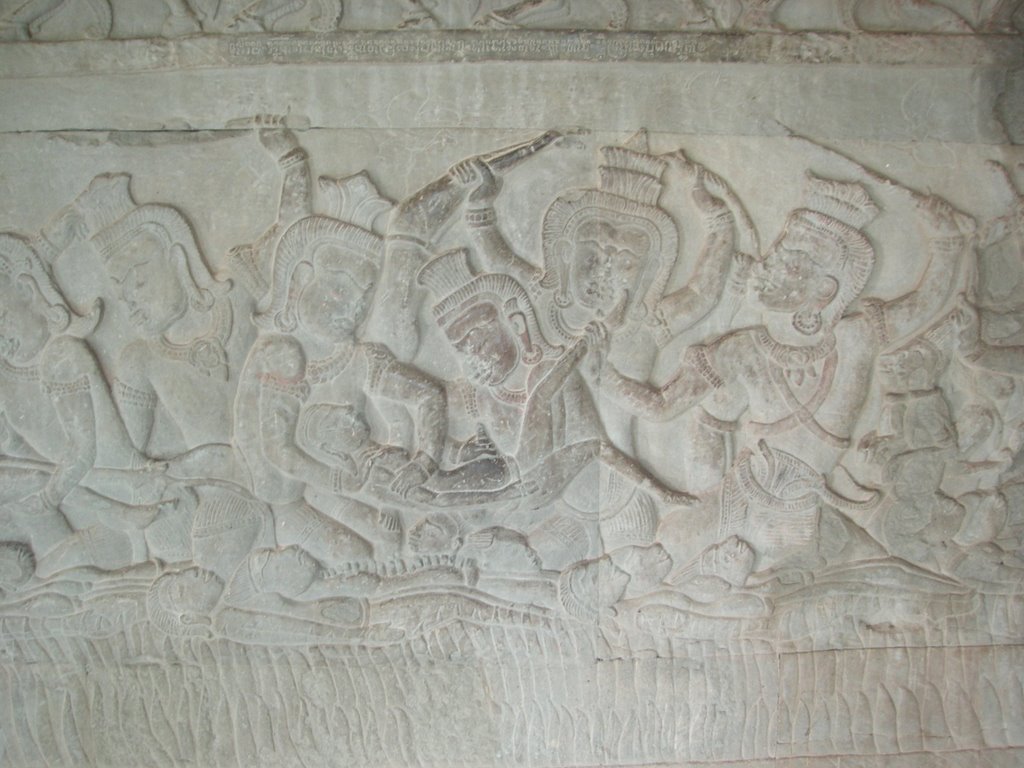
At Bayon's entrance religious women monks greet you/peddle you for money and to make an offering to Buddha. From my understanding the religion in Cambodia is a fusion of Hinduism and Buddhism, justufying Buddha's existence by claiming he is a reincarnation of Vishnu. In all the temples and in Angkor Wat palatial complex, there are incredibly complicated etched epics along all the walls. Emerging from the temple sites, there are usually market stalls with vendors selling every imaginable souvenir. The most beautiful silk scarves and silk handbags truly mark Cambodia;s survival in the textile industry, after the phase-out of quota system. From the International Labour Organisation, Cambodia is seen to have secured their markets in EU by promoting its high labor standards within its textile sector; but I'm always skeptical at this claim. And I defnly wish I had time to visit a silk farm and seen the extraction of silk from worms.

One of the most awestriking aspects about Cambodia is that about 70-80% of the country is under 21 years old, and only 20% of young girls finish primary school education. So when you see people over 40 you really notice. Does this mean that the textile industry is run by teenagers? How does that fit into ILO labor standards? There are many young marriages, with teenagers caring for their young children. It is really an interesting story in development that this country is built by such young people, all on motorbikes! Most young people speak English/French as well as Khmer. So I heard several stories from teenage shopkeepers that their parents were killed under the Khmer Rouge, and that they are bringing up their siblings. During the early morning when walking around some of the temples, young children beg tourists for US dollars while their older siblings run the market stalls and roadside cafes. In the late afternoon, children home from school spend their playtime selling trinkets to foreigners, (practicing their economics, geography and multiple languages). I;m not sure what to make of it all, given that I was there for such a short time, but the young people seem so resilient, charasmatic, charming, persistent, and the best salespeople I;ve ever seen in action!

Temple Bayon in Siem Riep


Last month we held a regional orientation on trade-related issues and porjections of the Doha Development Round on meeting human development goals. Participants from all over Asia and Pacific region gathered in Siem Riep, and in the early mornings before the programme started I was able to visit some of the surrounding temples, including Bayon. Angkor Wat, the ancient Siamese capital had been abandoned when Thailand invaded it around 12th century. Malaria outbreaks and the high cost of running the massive city contributed to rulers' languid approach when invaders took over. For several centuries the city was left in ruins, for the rainforest to devour it. In 1920s a French traveller came across the intricately carved faces of Bayon, peering out eerily behind the jungle's curtains.

23 April 2006

Only the tiles of the floors were left


A brief trip south to Galle revealed on a very vivid, horrifying scale the impact of the tsunami on people living in the south and east of Sri Lanka. Colombo had relatively little damage and human loss, only there is a surge of displaced people and migrants who continually come to the large city in search of employment and their familial ties. But the trail of devastation accompanies your journey down to the southernmost tip of the country. Entire houses, shops, lives and livelihoods were swept away, with the shocking remnants of their concrete slab kitchen sinks and tiled floors still jutting out. Those people killed are generally buried in mass graves along the sea-facing road. Many of the former inhabitants moved in with their families, and despite official reports that most survivors are taken care of, people still live in donated tents, forage for food and stable income, and wait on their daily relief. Ironically, you see that many people used UNHCR tents to tarp over the damage in their homes.

It was difficult to walk around the tent cities, or to gawk at the destruction, or to treat this tragedy as a tourist attraction, so I can only speak from memory (an erroneous source in itself). And it is absolutely incomprehensible that one year plus some months later that little of the aid from governments in the region, the UN funds, and NGO assistance have gotten back to the survivors. These people survived 20 years of conflict, the 'Big Wave' and now face the challenges of international 'benevolence' and 'aid capitalism.' For sure, this humanitarian disaster received the largest amount of aid and international outreach in history, but the methods of distribution, monitoring funds, local consultation and ethics have been grotesque, imperial, shady to say the least.

For instance, it's a massive mistake to have handed over the billions of funds to a corrupt, warmongering government, who's already misspent monies, in part on military expenses (whoah - how familiar is this experience in the western hemisphere?). More fundamental are the inherent flaws of the international aid architecture, that do not take in the very particular circumstances within the country needing the relief. Namely, they do not take in the complexities of aid in post-conflict recovery or on using the established networks of organisations already working in the country/region. Instead, alot of organisations inexperienced in Sri Lanka flooded the affected areas with their well-meanings and good intentions, but contributed to chaos and poor decisions. Many foreign volunteers do not speak the language and treat survivors with paternalism rather than listening with compassion. According to Sri Lankan social scientist, Dr. Darini Rajasingham Senanayake, "Each one of their air tickets and per diems may have paid for the rebuilding of a couple of tsunami-devastated homes." It does more good to employ/mobilise the underemployed university graduates, who may have a more sound grasp on the local situation, to carry out the relief work. Some of the negative reprecussions from the uncoordinated or ill-advised programmes can be seen as a disjuncture between state control of immediate international funds and its own agenda, and community knowledge and development initiatives.

One of the most gruesome outcomes from lack of coordination, includes how the looming possibility of returning to conflict, created a demand for LTTE recruits. Many children orphaned by the tsunami since have been recruited as child soldiers and trafficked into sex work to cater to the foreign paedophiles. In addition, areas that cater more to business and tourism received more immediate attention and relief in order to quickly resume one of the main service industries on the island. Approximately 55,000 temporary houses have been built in southern region but only one around Jaffna. Tamil people often face added, unjust hardships by the Government of Sri Lanka, who penalise survivors for being in the 'wrong' part of the country, not on the Singhalese side. Preventing relief agencies to come into the north and east by the LTTE, as well as the government's poor decisions not to focus on largely Tamil communities north, could exacerbate the teetering conflict. Moreover, while temporary housing is more available, permanent housing and strategies for long term recovery are still unfolding.

It is clear that the enormous funds pouring in internationally need to be held accountable to the survivors and distribution in Sri Lanka requires more effective monitoring. UN agencies have good transparency in terms of their funding expenditure, but bureacracy has tied up alot of the aid, instead of getting back to people (UN is angrily frowned upon here - best not to mention affiliation). As well, using aid to attain political ends exacerbates the conflict and hardships endured by the affected communities. How do we link established organisations working here to (larger, international) organisations that have the capabilities to expand project operations so that these juggernauts of relief and recovery can really manage sustained development?

In reference to article by:
Dr. Darini Rajasingham Senanayake."Humanitarian Assistance and Disaster Management: Lessons from Sri Lanka and India" ASEAN Roundtable 2005: The Asian Tsunami: Implications for Regional Development and Security, Institute of Southeast Asia Studies, Singapore

09 March 2006

Kokila


Named for the white bird that perches on water buffalo in rice paddies, she is a a woman, my age, working as a maid for my landlords. Her sister previously worked here, but being only 16, she became too homesick to work and returned back to tea country to send Kokila in her place. Both young women share huge smiles, yet deep sadness in their eyes. Kokila collects newspaper clippings of Tamil Bollywood stars and keeps them in a scrap book, and she tracks all the soap operas on telly. She can explain (using chef and body language to interpret) all the gossip in Bollywood and that one actor, Veejay, is visiting Colombo in June. But she cannot cook well and has no interest in doing housework. Nason, the chef, resents incompetence and other workers for their 'bad' manners, most likely because he's the only one who works 18 hrs a day with little rest. He has been trying to get rid of Kokila for some time and I came to realise it is because she sells sex to one of my beastly neighbours.

The landlords found out that one of the gardners pimps her out, so now they try to keep their eyes on her. However, they are lawyers and are often not around. I tried to reason with the chef that she could need the money for her young child, who is being taken care of by her family. Or that she could care less about the domestic work when she is given gifts, clothes, jewelry, money for her other informal services. Or that she seeks to be with men because she had abusive, alcoholic father (common case particularly in rural communities, like the tea village where she grew up). But Nason insists that she is a bad person and should be thrown out on the streets. Meanwhile, the men, like the gardner pimp, the obese beast, the employer who doesn;t intervene, and the critical gaze of the cook, are off the hook in this scenario. Hardly is their complicity questioned. Whatever Kokila's reasons for turning tricks on the side, why is it acceptable for these men to continue this behavior with no consequences? It will be Kokila who loses her job, and potentially stable income for her family and kid.

What I cannot endorse is the easiest thing that is done here, which is to ignore, put problems aside, look the other way. These class divisions and notions of superiority are most visible within the organisation where I work. It makes me nauseous to learn that none of the national staff have permanent contracts and that fast-track health care for them is only being negotiated now (health care is free for Sri Lankans, but some form of private insurance has more perks/quality). One amazing, overqualified colleague has degrees in micro-biology and human resource management. She was demoted to asst HR mngr without notice, while they hired another woman to take her position. It makes absolutely no sense; meanwhile we pretend that everything is fine, equitable, and that we are building alternatives. At least the private sector is more blatent about screwing people over for profit, rather than pretending it's working to achieve MDGs and improve the human condition. I'm quite bitter that some people in this field will trample on every human being for their own personal glory. Don't get me wrong, I really enjoy most people I work with; just that management needs to improve significantly. Perhaps managers could be trained in human rights or something before working in human development?

Just a few threads to highlight the continuous hardships that many women must endure, on all levels.

But for some good news, in Rio de Janeiro women prostitutes are lobbying to legitimise prostitution by creating their own clothing line. Retired hookers design and sew the clothing, but I wonder if it's fair trade? As well, in a strategic essentialist way, women are banding together and organising to call for an end to the occupation in Iraq. Look out for these peaceniks in a town near you. So yeah, can we get on with it please?

04 March 2006

it's impossible to reform things from the inside when these institutions are just bureaucratic nightmares...

how do we/i work to change unfair aspects of the world, like trading rules, when the inside of these development institutions are soulless bureaucratic dustbins? just alot of shuffling papers and backstabbing politics amongst economists. meanwhile the revolutions, coups (i.e. latin american, filipino, nepali) and other social movements are filled with similar, perpetual inequalities and discriminations, particularly that women's work and social networks are unrecognised and used by dominant elites (read: men) to give them a leg up on seats of power. im waiting for a revolution by cats.


STATEMENT FROM WOMEN HOUSEWIVES WORKERS IN THE HOME TO OUR PRESIDENT
HUGO CHAVEZ FRIAS - 4 February 2006

We see the need to issue this statement given the imminent emergency
of having to spend another year without a budget or begging here and
there for resources in order to guarantee people's participation in
the direct exercise of participatory democracy and grassroots
sovereignty.

We have been working for five years as the Red Popular de Los Altos
Mirandinos (Grassroots Network of Los Altos), Miranda State,
Municipality of Guaicaipuro, with connections in Aragua, La Guaira,
M・ida and Valencia spreading information on the creation of the Land
Committees Urban and Rural, and the setting up of the Mesas Tecnicas
Locales (Local Technical Committees). In those five years we have
designed and carried out property surveys, population censuses,
socioeconomic studies, and workshops with their own methodology for
topography, seismology and urban planning. Our experience also
includes working with the Consejo de Economia Social (the Social
Economic Council) since its creation three years ago. There we worked
on developing projects and budgets, and on selecting projects and
studying their feasibility within the communities. We were also
involved in the creation of the Red de Usuarias y Aliadas del Banco de
Desarrollo de la Mujer (Network of Users and Allies of the Women's
Development Bank) Banmujer. There too we carried out a selection
process using a socioeconomic study to locate the women with the
greatest need. We gave workshops on ideological training for the
creation of a caring economy. From this selection process we developed
the criteria used to deliver 120 credits between 2003-04 and to locate
the Casas de Alimentacion (soup kitchens) and the Mercal
(State-subsidized markets for people on low incomes). The Land
Committee welcomed and found a location for the Mission Barrio Adentro
(the healthcare mission based in low-income neighbourhoods) and
supported the Cuban doctors while they set up the grassroots clinics.
We also provided support for the Consejos Comunales (Community
Councils) as they were being set up, and advised on the creation of
projects that were going to be selected for the Plan de Obras
Municipales (the Municipal Works Plan).

The great majority - between 70 and 80 per cent of participants
nationwide - are women housewives workers in the home who have become
community leaders and defenders of this revolution, this participatory
democracy. We are the women who are doing the work of carrying forward
this revolution. We work for free and we are treated with contempt by
the State bureaucracy - they take advantage of us by using our work to
project themselves politically and give themselves credibility,
appropriating the few resources we have managed to get after many
battles, and which they have the nerve to pretend to administer and
even operate. This has brought disappointment and despair to those who
believe in the President but not in the majority of those who surround
him. By stealing our projects and the resources needed to carry them
out, and denying our ability as grassroots organizations, they are
stealing the revolution and this unique and unrepeatable opportunity
to change the world.

The President announced yesterday that, as part of the redistribution
of the oil revenue, the work done in the home by women heads of
household - starting with those who live in extreme poverty - would be
recognized with a housewife's pension equivalent to 80% of the minimum
wage (that is 372.000 Bolivars a month) which would be paid to 100,000
women during the first semester of this year and to an additional
100,000 in the second semester. The President said that this would be
administered by the Ministry of Work and the Ministry of Popular
Economy, and that the beneficiaries would be put forward by the
Consejos Comunales and the Juntas Parroquiales (Parish Boards) which
would take account of the Land, Water and Health Committees and other
community organizations for monitoring and accountability. In order to
ensure that this economic recognition - which the women of Venezuela
and the world have fought so hard for - is delivered directly to those
entitled to it and doesn't stay in the pockets of bloodsucking
bureaucrats who live off the politics business, and who discredit the
government and corrupt any initiative that attempts to deepen the
revolutionary process, we propose the following points:

1. We do not want the resources to pass through the town hall, the
county hall, the parish or local councils, or other State institutions
which divert or steal this money.

2. We do not want the parties to decide who shall be the
beneficiaries of social programs because they use the Misiones to buy
votes.

3. We do not want the points of reference of grassroots
organizations to be manipulated and displaced in order to impose on us
civil servants and bureaucrats who know little about our reality.

4. Nor do we want the projects and initiatives to be stolen from
community leaders in order to be presented by the councils or the
county authorities as their own.

5. We do not want to be excluded with accusations that we are
escu・idos [the term that refers to the pro-coup opposition] if we
make any criticisms or point out something that isn't working that is
the responsibility of a government institution or programme. Rather,
we want to be respected as monitors of social expenditure and
guardians of this Bolivarian revolution.

We base this on our experiences as grassroots organizers who have been
forced to beg for what is ours by constitutional law. As Land
Committee we delivered the project we had worked on for five years
into the hands of our President on the Al・Presidente [Ch・ez's live
weekly TV and radio show] he did in Guaicaipuro, Miranda state. On
this programme our President committed himself to providing directly
to our organization the necessary funds to set up our local technical
office for the regularization of the tenancy deeds of urban lands.
Yet, we are still begging for scraps from the local authorities and
the city council in order to function. We still do not know what has
happened to those funds. Rumour has it that they are being held by the
governor's office or the national technical office, among other
bodies. We do not know.

Another example is the experience we've had with the Segundo Consejo
de Economia Popular (Second Council of Popular Economy) nationally
with the executing body FIDES; we were elected by the people at a
meeting of more than 500 citizens organized in work sessions. We were
trained for three months and we organized a project for a centre for
seven service-providing co-operatives, and we worked with it for a
year and a half. Yet the funds (365.000.000) have been withheld to
this day, and despite our many requests we have received no reply. The
only reply we want is the execution of the project.

One more example is that of the Land Committee at Ramo Verde, where
for 45 years 26 families have lived on a military base which belongs
to the Ministry of Defense. After many petitions, the Consejo Local de
Planificacion Publica (local public planning council) approved two of
their projects, one to build roads and another for electricity. Today,
after three years, they still haven't had a reply.

These are just a few examples of a general situation that exists
throughout the country. It has many variants and it is wearing us out
in the exercise of our grassroots sovereignty, running the risk that
these revolutionary proposals may be lost and with them our
revolution. We cannot allow this to happen and therefore we propose:

1. That the funds destined for workers in the home be paid
personally and directly through Banmujer, and that the selection be
made through the census of the Redes Populares de Usuarias y Aliadas
de Banmujer because our experience shows that this would guarantee
that the money is not stolen, that there is no partisanship or
cronyism, and that social justice prevails.

2. That the pension is not temporary but for life because women's
work is not temporary and never ends.

3. That they include the recognition of revolutionary community
work as productive work that should be remunerated. It is not right
that we the women who, as our President has said, are the foundation
of the revolution, have to depend on the charity of our partners and
relatives in order to carry out our revolutionary labour.

We have not expelled the elite along with its caste of corrupt
politicians and its regime of terror in order to make way for a new
generation of thieves who take advantage of our revolutionary work. We
will not allow our dedication towards the communities and the
revolution to be used to build a new form of exploitation and terror
against us, our people, our President and our revolution.

Red Popular de los Altos Mirandinos, Edo. Miranda, Municipio
Guaicaipuro Tel: 0414 104 0858 Lamadre-romero@hotmail.com

Copies to: Nora Casta・da, President of Banmujer; the Red Popular de
Usuarias of Banmujer in the State of Bolivar; Global Women's Strike

SIGNED BY:

NAME

SIGNATURE