(from Schnews.org.uk, Issue 524)
One of the many things under threat from planned liberalisation and expansion of international trade in services as negotiated behind closed doors in the World Trade Organisation (WTO) is libraries. ’Globalisation, Information and Libraries’, a new book by Ruth Rikowski, examines the implications for the world’s state-funded libraries of the WTO’s most infamous treaties - GATS (General Agreement on Trade in Services – see SchNEWS 378) and TRIPS (Trade-Related Aspects of Intellectual Property Rights - see SchNEWS 420).
GATS is a set of trade rules whereby WTO member countries must open up their service sectors to the global market. Assurances made by the UK government, the European Commission and the WTO, that all public services such as health, education, water, housing, and libraries are exempt from GATS are in fact bogus. There has been a steady process of commercialisation and private sector involvement in all the above listed public services over the last decade.
So, state-funded libraries in the UK and across the world will be forced, in time, to turn into profit-making enterprises that will open the door to long-term privatisation. Brighton already has its multi million pound PFI library. (See www.roughmusic.org.uk/#four) Although the UK (under the EU) has not so far committed its Library Service to the GATS, this could easily change in future negotiations, succumbing to private companies searching for ripe opportunities.
TRIPS, meanwhile, is about the trading of intellectual rights, including copyright, trade marks, geographical indications, patents, industrial designs and trade secrets. Rikowski shows that TRIPS is not concerned with moral and humane issues in regard to intellectual property, but instead allows corporations to appropriate, patent and then profit from the traditional knowledge of indigenous populations in the poorest developing countries without giving due recompense.
So GATS and TRIPS will continue transforming services and intellectual property rights into internationally tradable commodities, to be sold in the market-place for profit. As Rikowski says, “In Britain today we already have examples of private companies running public library services (e.g. in the London Borough of Haringey), and many examples of public-private partnerships building new libraries. Coupled with the growing pressures on libraries to generate income and operate more like private companies rather than public good providers, the ‘commercialisation by stealth’ of British libraries and information is an everyday reality. When a country signs up its Library Service to GATS it means that foreign corporations must be allowed the right to compete with local authorities and domestic firms for the provision of public library services. This will open up the way for privatisation which could threaten the British public library free at the point of use.”
* The book’s full snappy title is: Globalisation, Information and Libraries: the Implications of the World Trade Organisation’s GATS and TRIPS Agreements (Chandos) or check out www.libr.org/ISC/articles/19-R.Rikowski-1.html
12 December 2005

08 December 2005
Drunken elephants create havoc
The other day a herd of wild elephants drank fermenting Goda, a kind of moonshine?, at an illegal liquor den in the jungle. When they wandered into human settlements in Galewela district they created havoc and wildlife protection officials had to light firecrackers to chase away the herd. However, the elephants really enjoyed themselves, so they returned to the distillery at dawn on Sat, and ended up destroying crops in Wetakolupotha, Ulpathyaya, Narangasyaya and Meegasyaya villages..heheheeee!!!! -(from Daily Mirror, Tues, 6 Dec).
On Buddhist weddings, Slave Island, meeting the colleagues and post-Multi-Fibre Agreement
Fri, 2 December, 2005
Friday afternoon I finally met the people with whom I will be working, only, because it was Friday the office was slow and many people were on missions or giving training sessions. Moreover, the Trade and Investment cluster, where I will be researching, attended a colleague’s Buddhist wedding about 10km south of Colombo, in Mount Lavinia. Apparently, this area has an enormous resort and according to the astrology, Friday was a good, harmonious day to get married. There were three other weddings that day and about two hours worth of traffic, hence, it took awhile for Yumiko and Riza to return to Colombo and meet me. Eventually, they collected me in a taxi van, which then wound around the bigger, human-made Beira Lake in central Colombo.
It is a short, 10-minute drive to the offices from Cinnamon Grand Hotel, and while there are few green public spaces, in terms of parks, the city is enveloped by lush leafiness. People spill over everywhere! Traffic is intense during the week and people carrying buckets, laundry, market goods and just about anything you can imagine, on their heads, weave in and out of the congestion. Surrounding Beira Lake is a reputable section of the city, called Slave Island, with a posh shopping and dining street, I believe Duplication Rd. Slave Island was carved out by Dutch colonists in 1600s and irrigated with the two Beira Lakes, in order to house their Tamil, Sinhalese, etc slaves. I believe crocodiles still reside in the lake, which had been used to prevent slaves from escaping. Right, so this now lush district is near the office, off Vauxhall Road. While the surrounding area is quite lovely, Colombo has significant criminal activity and I am advised to go to work via a taxi or tuk-tuk, or three-wheel, covered motorized vehicle. Taxis are cheap, about $1-3 for the journey. Riding a bicycle would be suicide, unfortunately. Not to mention, the often 40-degree weather makes it ridiculously hot to ride. However, in other cities around Sri Lanka bicycles are the prominent way to get around and if I get a moment to travel to Galle, on the southern coast, or Kandy, in the centre, I will look into renting a bicycle. Thus, for those of you with the weather conditions and smoothly paved roads, get on a bike!
It is unfortunate to hear the advice of colleagues that (Western) women should not be keen on exploring on their own (yet, it is common to get acquaintances to chaperone you). Of course, there are the typical tourist areas, like the shopping on Galle Face Road, the bizarre Pettah Market, the museums and government offices around Cinnamon Gardens district and the casinos where it is patrolled and safe. Perhaps I’ll visit the museums and Pettah Market, but I’m not keen on the tourist attributes. It won’t make a difference what I do, I will always be a tourist here, one with money to spend (the average monthly income for most people is $50 USD – I’ll make 40 times that). But I can’t help but feel sheltered and isolated. While commuting to the offices and to Negombo I witness the liveliness, brightness, hub of activity all around me, yet I am cornered in a pristine ivory Cinnamon Grand Hotel tower, sort-to-speak. It’s bloody immaculate in here –too much for my cluttered, chaotic brain-- so should I only be content to catch a whiff of activity on quick jaunts? Pea green canals, turquoise Indian Ocean mirror the azul sky, scarlet and orange soil -(I wonder what is the soil consistency and stratigraphy)- sidewalks shoulder the main roads when leaving the city, dusty red and green tuk-tuks zip all around me, saris of every color, and a million eyes fixate on me. Of course, residing in an ivory tower, researching the Cambodian and Laos garment and textile working conditions *QUOI?!*, does not help my paranoia and anxiety, which I usually have while in North America.
Anywho, meeting my colleagues restabilises me in a sense. This Regional Centre originally stemmed from a Asia-Pacific Bureau, in New York, and divided itself in Bangkok, then Kathmandu. With the present conflict in Nepal’s capital, this centre moved to Colombo. The two regional centres concentrate on different projects, with gender mainstreaming built into both. This one in Colombo focuses on poverty, MDGs, pro-poor macro-economic policies, HIV/AIDS, gender, trade and globalisation, and crisis prevention. The two main initiatives (in response to collapse of WTO Ministerial in Cancun) deal with poverty reduction and linking trade with human development. While it is difficult to gauge how effective are the Trade and Investment cluster’s strategies, it generally sends its core programme officers on missions to help train government officials and other development personnel to make more effective, human development-centric policies. It produces different tracking and evaluation reports, organizes training workshops (such as on gender and trade), and hires a network of consultants to work in the region.
I hope to meet my boss ‘Butch’ and others next week, or after WTO 6th Ministerial. I’ll have to be wary of a fellow American research associate, Mac, who seems starved to talk to an American woman. Quite keen to “show me around”, but I can’t be bothered. From the few hours I spent at the offices on Friday afternoon, I learned about some of my upcoming projects, so I will be very busy. Yumiko and Mr. R.A. (formerly a leader of a South Asian farmers’ rights organization) are finishing a tracking report, a sort of one-year-since-the-end-of-the-Multi-Fibre-Agreement (MFA)-in-the-Asian-textile/garment-industry report. (Apparently, it’s not as bad as what many development folks predicted, I mean the shut down of 50 or so factories in Nepal, only resulted in an increased shift to prostitution for Nepalese women! Some women have migrated to other countries to send back remittances, but they also risk trafficking. Still it’s not as bad as in Bangladesh?! Not sure how one is supposed to compare the negative repercussions…I mean, the whole design of the garment industry is pants…[er, crap]!). Right now, I am trying to find out more information about a couple of our case studies’ working conditions. We only have time and interviewing resources to investigate Bangladesh, Cambodia, Pakistan, Sri Lanka, and (maybe Lao PDR and Nepal). Cambodia is lacking major information about working conditions, hours, wages, unionizing. Not surprisingly, the Ministry of Labor and private sector development in Cambodia tend to gloss over such pertinent information, so I am trying to rely on International Labor Organization (ILO), OXFAM , UNIFEM and previous UNDP Human Development reports (…I can’t use Workers’ Rights Consortium monitoring reports of Nike and Gap factories in Cambodia?). My briefing will only be a few pages, but is due Monday. I am trying to work on it in between attending sessions of the Economic Journalists conference. But it is difficult due to no internet at this resort…
…I will try to post my findings in some way…or provide links to final versions that go to press.
Friday afternoon I finally met the people with whom I will be working, only, because it was Friday the office was slow and many people were on missions or giving training sessions. Moreover, the Trade and Investment cluster, where I will be researching, attended a colleague’s Buddhist wedding about 10km south of Colombo, in Mount Lavinia. Apparently, this area has an enormous resort and according to the astrology, Friday was a good, harmonious day to get married. There were three other weddings that day and about two hours worth of traffic, hence, it took awhile for Yumiko and Riza to return to Colombo and meet me. Eventually, they collected me in a taxi van, which then wound around the bigger, human-made Beira Lake in central Colombo.
It is a short, 10-minute drive to the offices from Cinnamon Grand Hotel, and while there are few green public spaces, in terms of parks, the city is enveloped by lush leafiness. People spill over everywhere! Traffic is intense during the week and people carrying buckets, laundry, market goods and just about anything you can imagine, on their heads, weave in and out of the congestion. Surrounding Beira Lake is a reputable section of the city, called Slave Island, with a posh shopping and dining street, I believe Duplication Rd. Slave Island was carved out by Dutch colonists in 1600s and irrigated with the two Beira Lakes, in order to house their Tamil, Sinhalese, etc slaves. I believe crocodiles still reside in the lake, which had been used to prevent slaves from escaping. Right, so this now lush district is near the office, off Vauxhall Road. While the surrounding area is quite lovely, Colombo has significant criminal activity and I am advised to go to work via a taxi or tuk-tuk, or three-wheel, covered motorized vehicle. Taxis are cheap, about $1-3 for the journey. Riding a bicycle would be suicide, unfortunately. Not to mention, the often 40-degree weather makes it ridiculously hot to ride. However, in other cities around Sri Lanka bicycles are the prominent way to get around and if I get a moment to travel to Galle, on the southern coast, or Kandy, in the centre, I will look into renting a bicycle. Thus, for those of you with the weather conditions and smoothly paved roads, get on a bike!
It is unfortunate to hear the advice of colleagues that (Western) women should not be keen on exploring on their own (yet, it is common to get acquaintances to chaperone you). Of course, there are the typical tourist areas, like the shopping on Galle Face Road, the bizarre Pettah Market, the museums and government offices around Cinnamon Gardens district and the casinos where it is patrolled and safe. Perhaps I’ll visit the museums and Pettah Market, but I’m not keen on the tourist attributes. It won’t make a difference what I do, I will always be a tourist here, one with money to spend (the average monthly income for most people is $50 USD – I’ll make 40 times that). But I can’t help but feel sheltered and isolated. While commuting to the offices and to Negombo I witness the liveliness, brightness, hub of activity all around me, yet I am cornered in a pristine ivory Cinnamon Grand Hotel tower, sort-to-speak. It’s bloody immaculate in here –too much for my cluttered, chaotic brain-- so should I only be content to catch a whiff of activity on quick jaunts? Pea green canals, turquoise Indian Ocean mirror the azul sky, scarlet and orange soil -(I wonder what is the soil consistency and stratigraphy)- sidewalks shoulder the main roads when leaving the city, dusty red and green tuk-tuks zip all around me, saris of every color, and a million eyes fixate on me. Of course, residing in an ivory tower, researching the Cambodian and Laos garment and textile working conditions *QUOI?!*, does not help my paranoia and anxiety, which I usually have while in North America.
Anywho, meeting my colleagues restabilises me in a sense. This Regional Centre originally stemmed from a Asia-Pacific Bureau, in New York, and divided itself in Bangkok, then Kathmandu. With the present conflict in Nepal’s capital, this centre moved to Colombo. The two regional centres concentrate on different projects, with gender mainstreaming built into both. This one in Colombo focuses on poverty, MDGs, pro-poor macro-economic policies, HIV/AIDS, gender, trade and globalisation, and crisis prevention. The two main initiatives (in response to collapse of WTO Ministerial in Cancun) deal with poverty reduction and linking trade with human development. While it is difficult to gauge how effective are the Trade and Investment cluster’s strategies, it generally sends its core programme officers on missions to help train government officials and other development personnel to make more effective, human development-centric policies. It produces different tracking and evaluation reports, organizes training workshops (such as on gender and trade), and hires a network of consultants to work in the region.
I hope to meet my boss ‘Butch’ and others next week, or after WTO 6th Ministerial. I’ll have to be wary of a fellow American research associate, Mac, who seems starved to talk to an American woman. Quite keen to “show me around”, but I can’t be bothered. From the few hours I spent at the offices on Friday afternoon, I learned about some of my upcoming projects, so I will be very busy. Yumiko and Mr. R.A. (formerly a leader of a South Asian farmers’ rights organization) are finishing a tracking report, a sort of one-year-since-the-end-of-the-Multi-Fibre-Agreement (MFA)-in-the-Asian-textile/garment-industry report. (Apparently, it’s not as bad as what many development folks predicted, I mean the shut down of 50 or so factories in Nepal, only resulted in an increased shift to prostitution for Nepalese women! Some women have migrated to other countries to send back remittances, but they also risk trafficking. Still it’s not as bad as in Bangladesh?! Not sure how one is supposed to compare the negative repercussions…I mean, the whole design of the garment industry is pants…[er, crap]!). Right now, I am trying to find out more information about a couple of our case studies’ working conditions. We only have time and interviewing resources to investigate Bangladesh, Cambodia, Pakistan, Sri Lanka, and (maybe Lao PDR and Nepal). Cambodia is lacking major information about working conditions, hours, wages, unionizing. Not surprisingly, the Ministry of Labor and private sector development in Cambodia tend to gloss over such pertinent information, so I am trying to rely on International Labor Organization (ILO), OXFAM , UNIFEM and previous UNDP Human Development reports (…I can’t use Workers’ Rights Consortium monitoring reports of Nike and Gap factories in Cambodia?). My briefing will only be a few pages, but is due Monday. I am trying to work on it in between attending sessions of the Economic Journalists conference. But it is difficult due to no internet at this resort…
…I will try to post my findings in some way…or provide links to final versions that go to press.
06 December 2005
Negombo


...and two fantastic Pakistani economic journalists from the South Asia Centre for Economic Journalists, Ms. Shaista Malik and Mr. Amir Mohammad Khan.


More Excessive Wealth on the Island Still Coping with Tremendous Poverty
Despite some of this obvious hypocrisy and contradiction, I met some wonderful (and some lunatic egocentric) people at this training workshop. We have alot to do in edumacating the media about issues related to social justice and human development, namely that poverty is not a choice, impoverished people are not lazy, incompetant or unskilled, and that the paradigm of (economic) development predicated on tiers of technology, i.e. that agriculture -->garment/textiles --> industry --> services -->militarism -->supreme being --> nirvana, is unacceptable and grossly false! Anyway, below are some pictures of Dr. Saman Kelegama, Director of Institute on Policy Studies in Colombo, at sunrise...


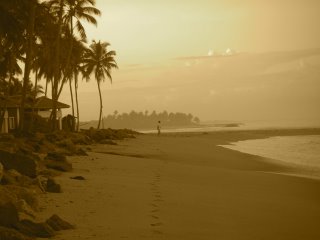


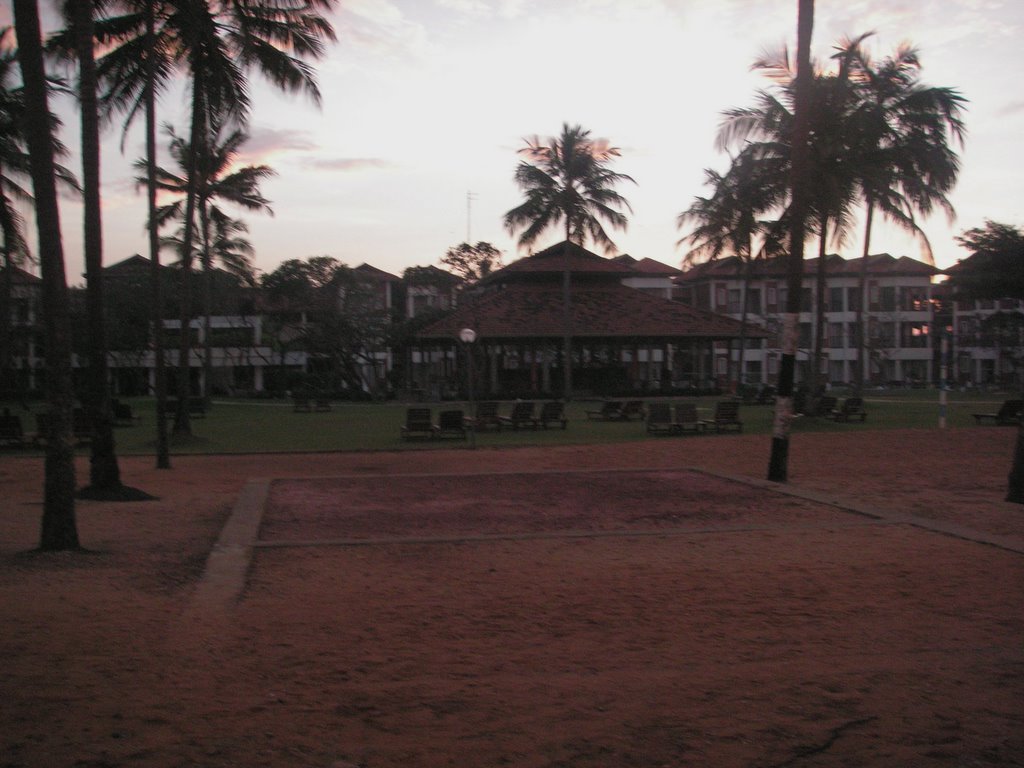


Club Hotel Dolphin in Negombo
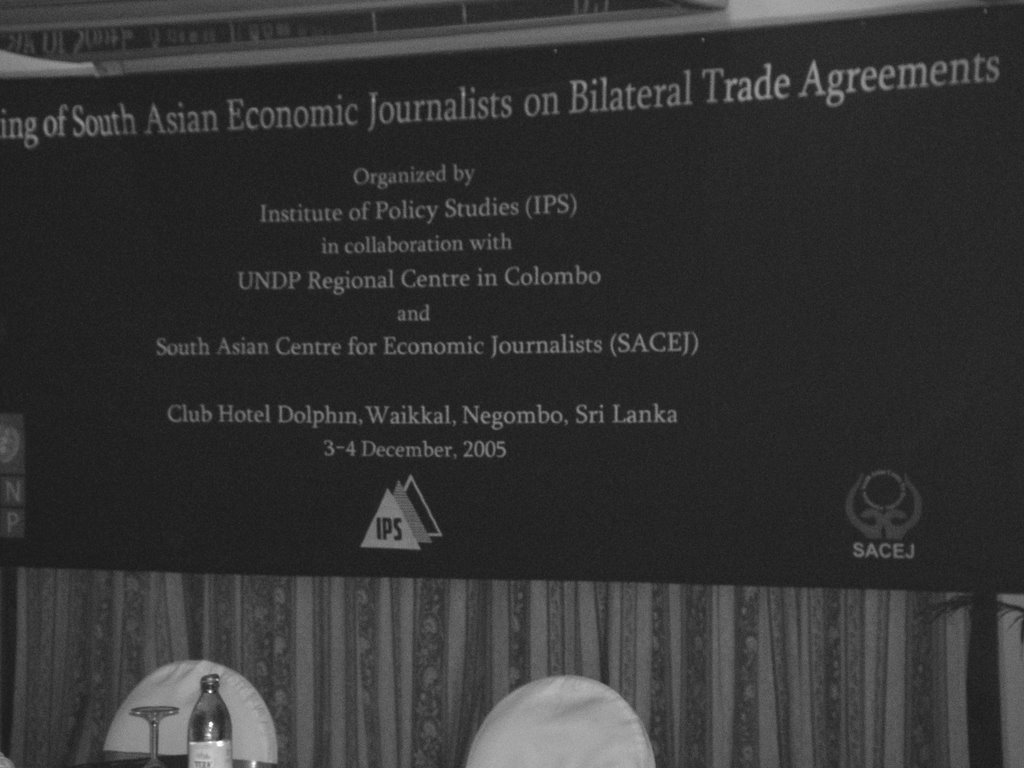
Hotel where the organisation I work for in Colombo organized training workshop for South Asian Centre for Economic Journalists. Basically, the workshop intended to 'build capacity' of economic journalists on the economic, legal, technical and social issues relating to North to South and South to South bilateral trade agreements (BTAs) in South Asia; to understand the poli-economic and human development aspects of BTAs; generate media activism on how the North is screwing over the South on regional and bilateral issues; and to improve the flow of academic research to public forums. I can post the agenda for those interested, but I regret that I can't post the draft papers and Powerpoints. However, there were some excellent discussions on intellectual property rights and Thailand case, which I will try to synopsize later.




Room with View of Colombo


I believe there is construction due to weather damage caused by tsunami and expansion of Cinnamon Grand Hotel, which is under new management. Inside there is an opulent dining room.
03 December 2005
Initial Update from Colombo
Wed – Thurs, 30 Nov – 1 Dec 2005
Initial thoughts, bloated and lacking fluidity from all the tea and champagne
After living it up for my last few days in New York by visiting friends, Lower East Manhattan cafes and flea markets, the South-east Asian exhibits at the Metropolitan Museum of Art and taking advantage of the mild weather in Central Park, I finally embarked on my journey to Sri Lanka. There had been some delay with the paperwork, due to bureaucracy at the human resource office in Bangkok and the backlog of visa approvals at the Sri Lankan Ministry of Foreign Affairs. In August, the Minister was assassinated creating increased security concerns and understandably, more red tape. I will try to comment the best I can about the current conflict in Sri Lanka, its politics and some ramifications of the newly elected Marxist president, (but from the advice of many close people, I will try to stay out of these politics, avoid discussing my perspectives on the American Empire whilst residing here, and stay as anonymous as possible – I really must learn to be more diplomatic about these things, and not as impassioned, without justification). However, I will attempt to work on other humanitarian projects, through volunteering, which deal with broader subjects such as relief, trade justice for small farmers and improving poverty alleviation.
In the meantime I have been doing some preliminary research on the Thai intellectual property rights (IPR) regime with respect to granting compulsory licensing for generic AIDS medicines. Could Thailand fill a gap for developing countries, by producing cheap meds and using south-south ties to get around US-led pharmaceutical doctrine, regarding the ludicrous 20-year patent monopoly rule on medicines? In addition, I have been trying to wrap my head around OECD countries’ financial aid for trade capacity-building (there’s that fun phrase again), regarding technical assistance in finding the best components of free trade agreements to suit least developed countries’ (LDCs’) development needs. Frankly, I think free trade will always be dodgy no matter how many flexibilities are used, but I’ve got to use UNDP development language and their acceptance of trade liberalization as effective in reducing poverty. (For a good time, look up UNDP’s definition of poverty…hm, there might be a lack of agency in impoverished peoples’ lives. Also, in my contract I do not think I can have conflicts of interest about the material, so no coarse, activist propaganda, and my intellectual diarrhoea will be copyrighted, or owned by the international organisation for which I work). What has been notable in the South-east Asian context in recent regional talks is the shift toward or larger attempts at south-south negotiations, that is, fulfilling one developing countries’ trade demands by seeking out partnerships with other developing countries, rather than continually relying on Northern ‘expertise’, supplies, etc. Or this is what I gather initially from the literature…
So from the start I am very excited about researching these different aspects and being challenged to become more familiar with the entire South Asian and Pacific trade context. Moreover, the treatment and outreach from the staff at this international organisation has been immensely helpful, patient and understanding. I think I will really enjoy learning from my new colleagues.
There are indeed a few surreal aspects to this kind of job opportunity, which I am struggling to negotiate. For instance, I flew business class on Emirates Airlines, amongst presumably wealthy individuals. I am interested to know who goes to Dubai for a good time…the odd yachting, horse race or oil crisis negotiation. It is very plush with chairs that massage, I drink champagne , and eat things called canapés . Also, I learned how to deal better with sycophantic airline personnel. “No, no thank you, I do not want to buy duty-free gems extracted using the worst kind of mining methods.” “Yes, that’s right, I’m young, on a student salary , and dress in jeans, excuse the offence at my very casual, thrift store attire.” “Do you not think that this lounge is wasting enormous amounts of food, water, electricity, and that genuineness is lost in this class type? Maybe we could turn off a few of these 800 lamps in the lounge; save a few trees by shifting to cloth (or hemp) napkins?” Not to be ungrateful or sarcastic (I am trying to leave these kinds of traits, commonly found in the West, behind), but I am not used to this lifestyle. I will no doubt have more income than most people I will meet in Sri Lanka and I will be able to live in a style of comfort that can be seen as absurd at times. Apologies in advance for some of my future brash comments, and I am still trying my best to deal with this change to a style of luxury by my standards. Moreover, when I arrived in Colombo I am initially put up in a 5-star hotel, the Colombo Plaza, now called Cinnamon Grand Hotel. I will send pictures of this outlandish ostentatiousness. I’m not quite sure how one researches poverty-related issues, the lunatic problems associated with IPR and best strategies for trade agreements when living in the lap of luxury, surrounded by other expatriates and tourists. We shall find out if this approach works best for contracted personnel at this large international development organisation, or reproduces loftiness and disconnect. I certainly look forward to when I can rent my own flat or maybe live with a family.
I arrived in Colombo Thurs. afternoon, greeted by the 400% humidity and 30-degree C tropical weather. From my first few conversations with Sri Lankan people, I think they are lovely, friendly and polite, and I think the women are stunning! An hour taxi drive into the city showed me another aspect because one must fight it out on the roads. Lots of cutting off, last minute stops and swearing. Madness across 7 informal/4 demarcated lanes, with a combination of cars, lorries, tuk-tuks, buses, motorcycles, bicycles, and pedestrians, with the odd train crisscrossing the highway. The road to the airport is lined with maquiladoras, housing Sri Lanka’s enormous garment industry. As comfortable as it is in North America to avoid discussing sweatshops (that everything we wear is made in them), exploitative labor or export-processing zones, you cannot avoid it here. They are everywhere, engulfing the city, and my taxi ride occurred right when many shift workers were leaving. I am not sure if the factories close at 5pm, or if a new shift takes over, but I am sure hours are stretched when factories must meet shipment deadlines. (Shipment deadlines, for instance, around back-to-school bonanzas and holiday hulla-baloo). At first I was in awe at the sight of brightly-clothed women, ranging from late teens to middle age, holding their long skirts, saris, and floral parasols, all walking in a strange parade, as they left their work. We know this is a women-driven industry, on the production and consumption ends, but is this also amusement, cute, engaging for men? It is interesting to see that many men stop their work in adjoining repair shops, restaurants and banks to hang around outside to witness this procession.
Something that is violently eating at me are the contradictions I simultaneously occupy. I am rich by Sri Lankan cost of living standards, but still feel like a poor student. I want to live modestly, but I must first live alongside the rich and famous (oddly, Michael Bolton is staying at my hotel, apparently catering to his large musical following in Sri Lanka—who knew?!). Already I am repulsed, nearly vomited at the reception counter, at the naivete and egocentrism of a couple other European tourists (and their derogatory treatment of hotel staff: that they should be waited on continuously and that staff gave them wrong directions on purpose).
I am also simultaneously too young and too mature. Sycophantic airline personnel, cluttering my head space, while hanging around me to satisfy any of my whims, indignantly kept asking me how old I was and suggested that I was too young to be in business class. Fair enough. Meanwhile, a couple people, including the taxi driver, questioned my marital status and why I am traveling alone. Apparently, at 24, I am too old not to be married and that I am a disgrace to my family because ‘they have to continue to take care of me?!’ No doubt not too many young women (all over) have this opportunity, nor can be this self-sufficient. And what I fear is that these contradictions – in trying to sort them out or by feeling guilty - might negatively influence my motivations for being here, for wanting to volunteer and for wanting to work in international development. ‘I will try the best I can…the best I can is good enough’? –Radiohead
On a final note, when I arrived in Colombo I had an evening to adjust, then I had to take care of the work visa on Friday. This weekend, I have been invited by colleagues to attend an Economic Journalists conference in Negombo, about an hour drive north of Colombo. It will be held at another plush beach resort (what?!), to discuss bilateral agreements in the region. I think it will be a fantastic opportunity to meet my new colleagues and learn a few things about the surrounding area of Colombo. Also, I have many travel ideas so that I can explore the country, (I would love to hike Adam’s Peak, and see pre-colonial palatial capitals Anuradhapura and Kandy, but I will most likely miss the annual elephant polo tournament in January --Elephants are a huge deal here! Lots of festivals and rites for celebrating them). I have also come across a couple awesome volunteer organizations. Habitat for Humanity has been a bit evasive, but I hope to get in contact by phone when I arrive. There is also MONLAR, a network of local farmers that is trying to come up with alternative trading strategies, which take into account small farmers’ concerns. As well, MONLAR facilitates seed sharing and provides some rehabilitative assistance for farmers devastated from the tsunami. I will elaborate on these possible volunteer opportunities once I am more settled and receive feedback. I should first see what are the demands for the UNDP job, as I will work at least 10-12 hour days. A lot less than I was spending in the Globn programme, so I hope there will be time for volunteering and traveling, which I could not do so much while in Canada.
These are just my initial thoughts as I begin this amazing opportunity. I hope to start a blog or photo journal to share with you. Hope everything is well on your end and more greetings later.
Missing you.
Peace.
Initial thoughts, bloated and lacking fluidity from all the tea and champagne
After living it up for my last few days in New York by visiting friends, Lower East Manhattan cafes and flea markets, the South-east Asian exhibits at the Metropolitan Museum of Art and taking advantage of the mild weather in Central Park, I finally embarked on my journey to Sri Lanka. There had been some delay with the paperwork, due to bureaucracy at the human resource office in Bangkok and the backlog of visa approvals at the Sri Lankan Ministry of Foreign Affairs. In August, the Minister was assassinated creating increased security concerns and understandably, more red tape. I will try to comment the best I can about the current conflict in Sri Lanka, its politics and some ramifications of the newly elected Marxist president, (but from the advice of many close people, I will try to stay out of these politics, avoid discussing my perspectives on the American Empire whilst residing here, and stay as anonymous as possible – I really must learn to be more diplomatic about these things, and not as impassioned, without justification). However, I will attempt to work on other humanitarian projects, through volunteering, which deal with broader subjects such as relief, trade justice for small farmers and improving poverty alleviation.
In the meantime I have been doing some preliminary research on the Thai intellectual property rights (IPR) regime with respect to granting compulsory licensing for generic AIDS medicines. Could Thailand fill a gap for developing countries, by producing cheap meds and using south-south ties to get around US-led pharmaceutical doctrine, regarding the ludicrous 20-year patent monopoly rule on medicines? In addition, I have been trying to wrap my head around OECD countries’ financial aid for trade capacity-building (there’s that fun phrase again), regarding technical assistance in finding the best components of free trade agreements to suit least developed countries’ (LDCs’) development needs. Frankly, I think free trade will always be dodgy no matter how many flexibilities are used, but I’ve got to use UNDP development language and their acceptance of trade liberalization as effective in reducing poverty. (For a good time, look up UNDP’s definition of poverty…hm, there might be a lack of agency in impoverished peoples’ lives. Also, in my contract I do not think I can have conflicts of interest about the material, so no coarse, activist propaganda, and my intellectual diarrhoea will be copyrighted, or owned by the international organisation for which I work). What has been notable in the South-east Asian context in recent regional talks is the shift toward or larger attempts at south-south negotiations, that is, fulfilling one developing countries’ trade demands by seeking out partnerships with other developing countries, rather than continually relying on Northern ‘expertise’, supplies, etc. Or this is what I gather initially from the literature…
So from the start I am very excited about researching these different aspects and being challenged to become more familiar with the entire South Asian and Pacific trade context. Moreover, the treatment and outreach from the staff at this international organisation has been immensely helpful, patient and understanding. I think I will really enjoy learning from my new colleagues.
There are indeed a few surreal aspects to this kind of job opportunity, which I am struggling to negotiate. For instance, I flew business class on Emirates Airlines, amongst presumably wealthy individuals. I am interested to know who goes to Dubai for a good time…the odd yachting, horse race or oil crisis negotiation. It is very plush with chairs that massage, I drink champagne , and eat things called canapés . Also, I learned how to deal better with sycophantic airline personnel. “No, no thank you, I do not want to buy duty-free gems extracted using the worst kind of mining methods.” “Yes, that’s right, I’m young, on a student salary , and dress in jeans, excuse the offence at my very casual, thrift store attire.” “Do you not think that this lounge is wasting enormous amounts of food, water, electricity, and that genuineness is lost in this class type? Maybe we could turn off a few of these 800 lamps in the lounge; save a few trees by shifting to cloth (or hemp) napkins?” Not to be ungrateful or sarcastic (I am trying to leave these kinds of traits, commonly found in the West, behind), but I am not used to this lifestyle. I will no doubt have more income than most people I will meet in Sri Lanka and I will be able to live in a style of comfort that can be seen as absurd at times. Apologies in advance for some of my future brash comments, and I am still trying my best to deal with this change to a style of luxury by my standards. Moreover, when I arrived in Colombo I am initially put up in a 5-star hotel, the Colombo Plaza, now called Cinnamon Grand Hotel. I will send pictures of this outlandish ostentatiousness. I’m not quite sure how one researches poverty-related issues, the lunatic problems associated with IPR and best strategies for trade agreements when living in the lap of luxury, surrounded by other expatriates and tourists. We shall find out if this approach works best for contracted personnel at this large international development organisation, or reproduces loftiness and disconnect. I certainly look forward to when I can rent my own flat or maybe live with a family.
I arrived in Colombo Thurs. afternoon, greeted by the 400% humidity and 30-degree C tropical weather. From my first few conversations with Sri Lankan people, I think they are lovely, friendly and polite, and I think the women are stunning! An hour taxi drive into the city showed me another aspect because one must fight it out on the roads. Lots of cutting off, last minute stops and swearing. Madness across 7 informal/4 demarcated lanes, with a combination of cars, lorries, tuk-tuks, buses, motorcycles, bicycles, and pedestrians, with the odd train crisscrossing the highway. The road to the airport is lined with maquiladoras, housing Sri Lanka’s enormous garment industry. As comfortable as it is in North America to avoid discussing sweatshops (that everything we wear is made in them), exploitative labor or export-processing zones, you cannot avoid it here. They are everywhere, engulfing the city, and my taxi ride occurred right when many shift workers were leaving. I am not sure if the factories close at 5pm, or if a new shift takes over, but I am sure hours are stretched when factories must meet shipment deadlines. (Shipment deadlines, for instance, around back-to-school bonanzas and holiday hulla-baloo). At first I was in awe at the sight of brightly-clothed women, ranging from late teens to middle age, holding their long skirts, saris, and floral parasols, all walking in a strange parade, as they left their work. We know this is a women-driven industry, on the production and consumption ends, but is this also amusement, cute, engaging for men? It is interesting to see that many men stop their work in adjoining repair shops, restaurants and banks to hang around outside to witness this procession.
Something that is violently eating at me are the contradictions I simultaneously occupy. I am rich by Sri Lankan cost of living standards, but still feel like a poor student. I want to live modestly, but I must first live alongside the rich and famous (oddly, Michael Bolton is staying at my hotel, apparently catering to his large musical following in Sri Lanka—who knew?!). Already I am repulsed, nearly vomited at the reception counter, at the naivete and egocentrism of a couple other European tourists (and their derogatory treatment of hotel staff: that they should be waited on continuously and that staff gave them wrong directions on purpose).
I am also simultaneously too young and too mature. Sycophantic airline personnel, cluttering my head space, while hanging around me to satisfy any of my whims, indignantly kept asking me how old I was and suggested that I was too young to be in business class. Fair enough. Meanwhile, a couple people, including the taxi driver, questioned my marital status and why I am traveling alone. Apparently, at 24, I am too old not to be married and that I am a disgrace to my family because ‘they have to continue to take care of me?!’ No doubt not too many young women (all over) have this opportunity, nor can be this self-sufficient. And what I fear is that these contradictions – in trying to sort them out or by feeling guilty - might negatively influence my motivations for being here, for wanting to volunteer and for wanting to work in international development. ‘I will try the best I can…the best I can is good enough’? –Radiohead
On a final note, when I arrived in Colombo I had an evening to adjust, then I had to take care of the work visa on Friday. This weekend, I have been invited by colleagues to attend an Economic Journalists conference in Negombo, about an hour drive north of Colombo. It will be held at another plush beach resort (what?!), to discuss bilateral agreements in the region. I think it will be a fantastic opportunity to meet my new colleagues and learn a few things about the surrounding area of Colombo. Also, I have many travel ideas so that I can explore the country, (I would love to hike Adam’s Peak, and see pre-colonial palatial capitals Anuradhapura and Kandy, but I will most likely miss the annual elephant polo tournament in January --Elephants are a huge deal here! Lots of festivals and rites for celebrating them). I have also come across a couple awesome volunteer organizations. Habitat for Humanity has been a bit evasive, but I hope to get in contact by phone when I arrive. There is also MONLAR, a network of local farmers that is trying to come up with alternative trading strategies, which take into account small farmers’ concerns. As well, MONLAR facilitates seed sharing and provides some rehabilitative assistance for farmers devastated from the tsunami. I will elaborate on these possible volunteer opportunities once I am more settled and receive feedback. I should first see what are the demands for the UNDP job, as I will work at least 10-12 hour days. A lot less than I was spending in the Globn programme, so I hope there will be time for volunteering and traveling, which I could not do so much while in Canada.
These are just my initial thoughts as I begin this amazing opportunity. I hope to start a blog or photo journal to share with you. Hope everything is well on your end and more greetings later.
Missing you.
Peace.
Subscribe to:
Comments (Atom)