06 June 2006

India's eunuchs


India's eunuchs seek new way

By Sanghamitra Chakraborty in Tamil Nadu

Eunuchs have been ostracised for years.

Sudha is dusky and wears a salwar kameez, a traditional dress for women in India, but no make-up. She is a eunuch (or "aruvani" as they now prefer to be called) and represents a group of transsexuals seeking respect for their identity and greater acceptance in society.

"While transgender people must protect their identity, we are willing to do our bit to gain acceptance," says Sudha on the sidelines of a community festival in southern Tamil Nadu state.

"If necessary we will dress down, tone down our speech, even desist from the commonly misunderstood practice of 'clapping' and negotiate with people in work and social settings." Since most hijras end up being stereotyped as cross-dressing men, feared for their lewdness and aggression, the aruvanis face many day-to-day challenges, linked with their identity.


New tactics
For most hijras, as Indian transsexuals are called, their physical appearance is an extension of their transgender identity. Lavish doses of make-up, flowing wigs, harsh, staccato clapping and aggressively sexual speech and body language are tokens of belonging, entrenched at an early age by community leaders.

Aruna and her friends want eunuchs to tone down their behaviour. Sudha and her friends want hijras to change tactics to win acceptance. Eunuch groups now participate in community-led inter-personal communication sessions regularly in what they see as a pragmatic way to learn how to negotiate with the mainstream.

"We are focusing on the aruvani being a woman in day-to-day life, not just in front of the mirror at home," says Sudha.
Bharathi Kannamma, an eunuch who edits a community journal, says the communication sessions seem to be addressing the problem.

"Earlier, when aruvanis were teased or harassed, they fought back often by shouting and using foul abuse. This created a bad impression in the minds of the general community," she says.


Spreading awareness
A trainer, Rajakumari, says eunuchs are much more in control of their lives after attending the sessions. "We aruvanis have achieved in the past two years what was left undone in the past 20 years. Wait and see what young aruvanis can do."

Aruna, transsexual
"When people mock or tease them, they don't take off in a rage as they understand that the public can be ignorant or insensitive," she says.

There is more on the minds of the aruvanis than celebrating their yearly festival in the village of Koovagam in Tamil Nadu.
"We're fighting for our right to live and work with dignity as other women do. The violence against transgender people must stop," says Sudha's friend Aruna, who marched along with 500 other transgender protesters.

"They lead many self-help groups working in Tamil Nadu, spreading awareness about safe sex and HIV to hundreds of transsexuals, many of whom are sex workers or beggars." Delhi-based historian activist Mario D' Penha says there is a "huge debate" raging in the eunuch community "about the right path to integration and whether they should be seen as eunuchs or women".

Not recognised as females by law, these castrated males face a very real identity crisis. Once their surgery has taken place they are no longer considered male and there is no legal framework in place to deal with them.

Eunuchs in India face an identity crisis

One of the most important aspects of the training is to impress upon the community the need for safe sex. Since many of them are extremely vulnerable to HIV, given their social isolation and low literacy levels, short films, documentaries and modern parables are used to improve social skills and to highlight health issues, such as the need to use condoms.

"From living on the fringes of society, they are not only working towards 'mainstreaming' themselves, but are now focusing on expression of their hidden talents that can contribute to them being accepted as citizens in their own rights," says Dr R Lakshmi Bai, chief of a local HIV prevention project.

Aruna is hopeful about the future. "This is the way to go. We aruvanis have achieved in the past two years what was left undone in the past 20 years. Wait and see what young aruvanis can do."
04 June 2006

Talk about human interconnectedness!


Apparently, Nason, the cook who worked for my landlady and ran away around the time of Hindu New Year, was involved in the Colombo suicide attack. While we idly chatted about Sri Lankan cuisine, whether you add turmeric or ground ‘katagum’ to lady finger curry, three or four women took up residence in Nason’s apartment in Pettah district, Colombo 01. While Nason claims he is from Kandy – near Hunas Falls – he has an Indian Tamil accent, according to the landlady.

The LTTE is well equipped, with imported, contraband weapons and military-related technologies. Skilled technicians can operate satellite-controlled weapons; they have warplanes and ships. They have the military might, jaded youth to comprise their army, funds extorted from the global Tamil diaspora, the immense corruption within Sri Lankan government to work to their advantage, and a thirst for bloodshed, but no state. Meanwhile the flaccid, malevolent, racist government that is recognised and supported by the international community, is losing ground in terms of its military capacity and definitions for a peaceful future. So the back alleyways and shady wheeling and dealings rule this country; be prepared to bribe your way through it. With economic development and job growth only concentrated in Colombo, disenfranchisement, abject poverty, hopelessness looms in the rest of the country. It’s an easy entry point for the LTTE to ‘swoop in’ to offer jobs, cold hard cash, and a glimpse of infamy to many people living in poverty, primarily to Tamils like Nason.

I do not know the whole story of Nason’s involvement, only that the military police frequently stop by the residence to question my landlady, as his former employer. It is believed that he harboured in his apartment three or four women, possibly former garment workers, who knew the pregnant suicide bomber. It is possible that these women helped to get her fake identity cards, or they could have monitored the Army Headquarters and Hospital to check when the head of the Army arrived to the compound after lunch. Nason evidently knew everything about attack, and has since vanished, along with the three or four women accomplices. His daughter, Wani, who I met on her birthday, still calls the landlady to find out where he is. If he is discovered in Sri Lanka he will likely be detained, questioned with torture, imprisoned and executed in the most inhumane, incomprehensible way – many of the ‘disappeared’ Tamils who ended up in government hands during the last 20 years were cut into pieces and their mark on history was erased from within their unmarked, mass graves.

The blast that occurred on 27 April, injured an high-ranking army general, and killed several people including his driver and bodyguard. A young woman, plotted with the LTTE to become pregnant in order to qualify for maternity services at the Army hospital. Her fake papers stated that her husband was a Singhalese officer. This meticulous plan was carried out over six or seven months, all throughout the peace talks, lowlighting that the LTTE was never really serious about securing, long-term, sustainable peace. And I’m just in awe to know what went through this young woman’s head, how was she convinced to become a part of this scheme? Am I too bold to believe that this is a blatant attempt by masculinised military institutions to play on women’s perceived roles as mother/nurturer/docile/obedient/subordinate in order to achieve archaic, dehumanizing, violent ends? These perceived gender roles are more pronounced here, so it is not surprising that this pregnant LTTE cadre was never searched or questioned when she entered the compound. Or is it a way for the LTTE to show that it is willing to sacrifice its people (and instead offer a childless future) until it gets what it wants – in a rather disgusting tantrum?

The folks in Colombo – particularly the foreigners - are still shaken by the immense violence that shrouds this talented, beautiful, glorious ‘pearl of the Indian Ocean’. And most people I talk to cannot wrap their heads around these events. But I wonder if by the LTTE using a young woman and unborn child to scaremonger the comparably rich denizens of Colombo into reacting, into giving land rights, recognition of state, sovereignty…if they do not just undermine their cause? If they do not just fit more easily into the rest of the world’s misguided, simplistic, dichotomous conceptions about terrorism, i.e. Hollywood ‘good’ vs. ‘evil.’ With no value for human life, how can this circle of so-called leftist intellectuals and foreign-educated elites pretend that they are fighting for the ‘dignity’ of Tamils in Sri Lanka? What about the Tamil tea pickers, completely fucked over by North and East Tamil communities, by Singhalese compatriots, and by foreign plantation owners, investors and probably the slough of foreign development workers? What about the Veddah indigenous peoples also absent in the discussions on how the former colony of Ceylon should operate, implement human rights, and grant access to basic services and profound freedoms? Hence the pernicious fight between zealous Buddhist nationalists and a corrupt circle of criminals claiming to represent the views of the marginalised Tamil communities, sees no end. One colleague described this war in everything but name, as the only way for the LTTE to assert its existence, because it could not face the arduous task of forming a separate state and all that entails.

We are all complicit in this Sri Lankan ‘uncivil’ war, (in all wars against humanity) moreso when we do nothing to speak out for peace, worldwide and at home. I am inconsolable about my complicity knowing that my connection to all of it is right under my nose and I can do little to prevent it from happening. Moreover, you really cannot trust anyone.

19 May 2006

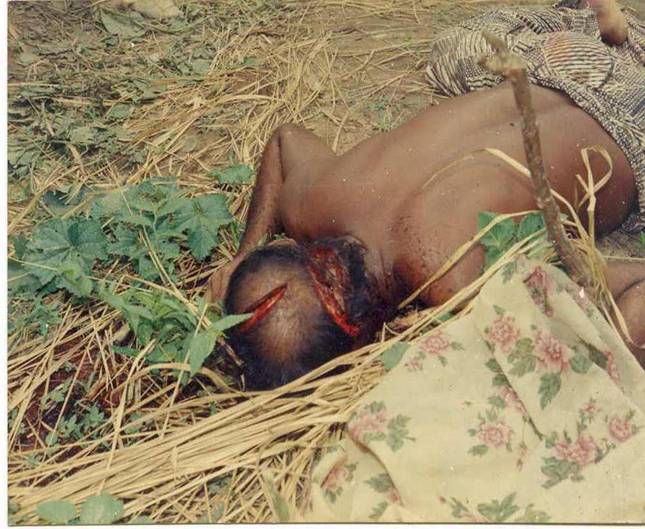
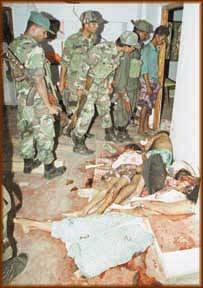
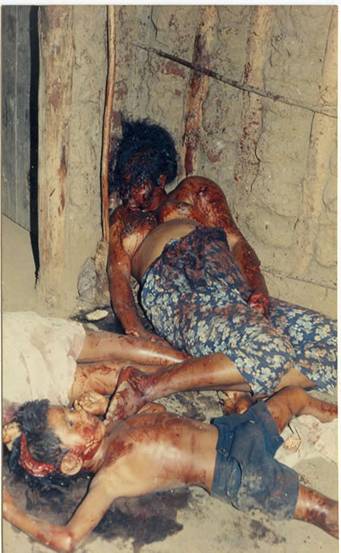
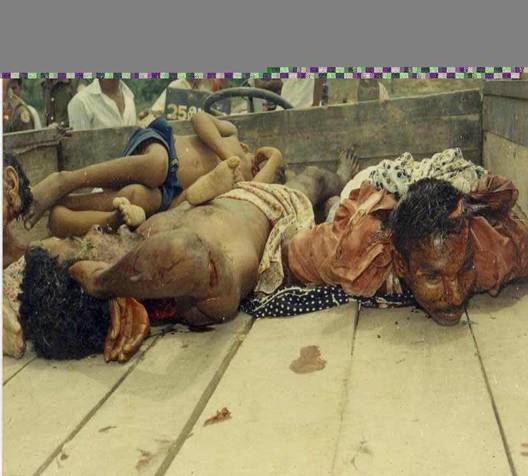
Warning: Gruesome!


To let us remember those massacred, whose identity the government-backed media tries to conceal

Let us remember that war is not a numbers game, or a way to promote one's power or might, but that primarily it is a loss of life, individuality, sweetness of human character, and extinguishes the potential for future generations to correct past brutal, warmongering mistakes. The conflict in Sri Lanka is going in circles, many of the recent attacks replicate those from the last 20 years.


A story written by friend of my Sri Lankan colleague, to shed light on this massacre in November 1995.


Night was falling. My Kiri Amma (grand mother) retuned through paddy field directing a herd of cattle back home. She had vaguely seen some strange boys in dark suits sitting by the pathway, in unusual places. She was old, eyesight was poor. If not, that wouldn't have been the last time she returned home. There were 13 homes in our village. Many were poor farmers. There was one home with a TV. As it was Sunday, we all gathered there to watch the tele drama. Seneviratne mama was cleaver; he said "we all should not stay here for long". He came to the road & found some strangers positioning around the place we gathered. Having nothing for his defense, he shouted. That was a call for others to flee. We heard gun fire, it was for Senevi mama. He laid down his life and saved some lives, because tigers had to start shooing before they circled the village completely.

Though we tried to run away, tigers were around us. My chuti nangi (little sister) was 4 yrs then, she did not eat without listening to a story. My brother was writing something in his school book. Suddenly

Tigers hit the front door. It was not made up of strong wood, so my father kept pushing from inside preventing force opening. When that failed, tigers fired several shots at my father thru the door, he fell still trying to keep it closed. They dashed inside, kicked my father's body away and chopped the head away. My mother held 3 of us firmly, trying in vain to cover us with her hands. When a tiger aimed his gun at us, she pleaded to leave the children. He went back

And came with another lady tiger. She had a sword. She grabbed my chuti nangi away from my mother's lap and cut her neck off. Then my brother because he tried to say something. Then my mother. When tiger girl hit my mother's neck with the sword, I fainted. Whole night long, I cried trying to wake up my mother. She jerked few times, and became silent. Her blood was warm, same warmth 3 children cherished until this day.

Whole night, I heard gun fires and my relatives crying. With each gun shot, their voices dwindled. I heard Renuka nenda crying next door, pleading them to kill her. Later I learnt why she pleased that way. A tiger man beheaded her mother, father, 3 brothers and only sister and

Brought all 6 heads to the road. They shot at the house opposite mine, then dashed in. There they killed Nawaratne mama's mother (my kiri amma), his elder bother, nanda and two daughters.

Following morning, many people came to see this wonder, one big person (a politician) even came in a helicopter. Bodies were collected by Army men and prepared for last rights but they could not reach the village cemetery because, tiger men were still waiting in ambush. There was another fire fight too. Then a bulldozer came and cut a mass grave and all bodies were laid in it and closed. Those killed on this day were,

1. K.R Amarasinghe Karunaratne

2. Punchiralage Somawathi

3. Saman Ravidralal Amarasinghe

4. Kumudu Nalanee Amarasinghe

5. A.Hethuhami

6. Nimal Karunartne

7. Mallika Damaynthi Karunaratne

8. Nadeeka Sandamalee Munasinghe

9. Pradeepa Sandamalee Munasinghe

10. Pulinguralage Chandradasa

11. Kapuruhamige Dhanapala

12. Sumudu Seneviratne

13. Murugathage Tikiribada

14. Jayantha Jayasiri Ranasinghe

15. Tikiri Bandage Siriyalatha

16. Piyadasage Nandaseeli

17. Gunasekarae Nimalwanshe

18. Piyasenage Wijesena

19. Nimal Wanshage Sriyani Surangika Nomalwanshe

20. Nimal Wanshage Priyanthe Nimalwanshe

21. R.D.A.Chadradasa

22. Malhami Punchibandage Kumarashinghe

23. Podi Appuhamige Seethawathi

24. Kumarasinghage Sisira Kumarasinghe

25. Kumarasinghage Samantha Kumarasinghe

26. Kumarasinghage Malkanthi Kumarasinghe

27. Mudalihamige Piyasena

28. Herathamige Tikirihami

29. Piyasenage Piyanka

30. Piyasenage Sunethra Nandani

31. Piyasenage Milinawathi

32. Piyasenage Nuwan Kumara

33. Piyasenage Rohana Sisira Kumara

34. Niluka Thilakasiri

35. Kumarasinghage Gamini Upathissa Kumarasinghe

36. Manthihamige Piyasena

37. Mudalihamige kalyanawathi

38. P.Sriyani Kusumalatha

39. P.Ramani Niranjala

40. P.Manori Priyanga

41. Mudalihamige Rangiethana

42. Wickramadasage Ranjana Jayakodi

43. Kandappurale Bedderalage Malhami

44. Siral Mohottalage Bebi Ethani.

16 May 2006

Update:a note on Vesak

I will continue to work in Sri Lanka even if the whole place goes up in flames. They have invested too much into this place (just had the inauguration) that they won't move. LTTE would be lunatic to attack an international place; they mainly target nationals, civilian places of interest, and try to impact the government's sources of revenue, i.e. WTC, financial sector. And since only poor civilians are mass murdered, the rich politicians in power do not get affected or make moves to remedy their own genocidal militarisitic tendencies.

There have not been any other attacks in Colombo since the last pregnant woman guerilla. But now the LTTE has taken to the seas and has kidnapped a gov't naval ship in which several Norwegian peace monitors were on board. It is strange since I had just gone to a SLMM (Peace monitors) party the weekend before and met several of the peace keepers. Lovely, lively, funny and stressed out folks. For now, life remains unusual, surreal and a bit disconnected from reality.

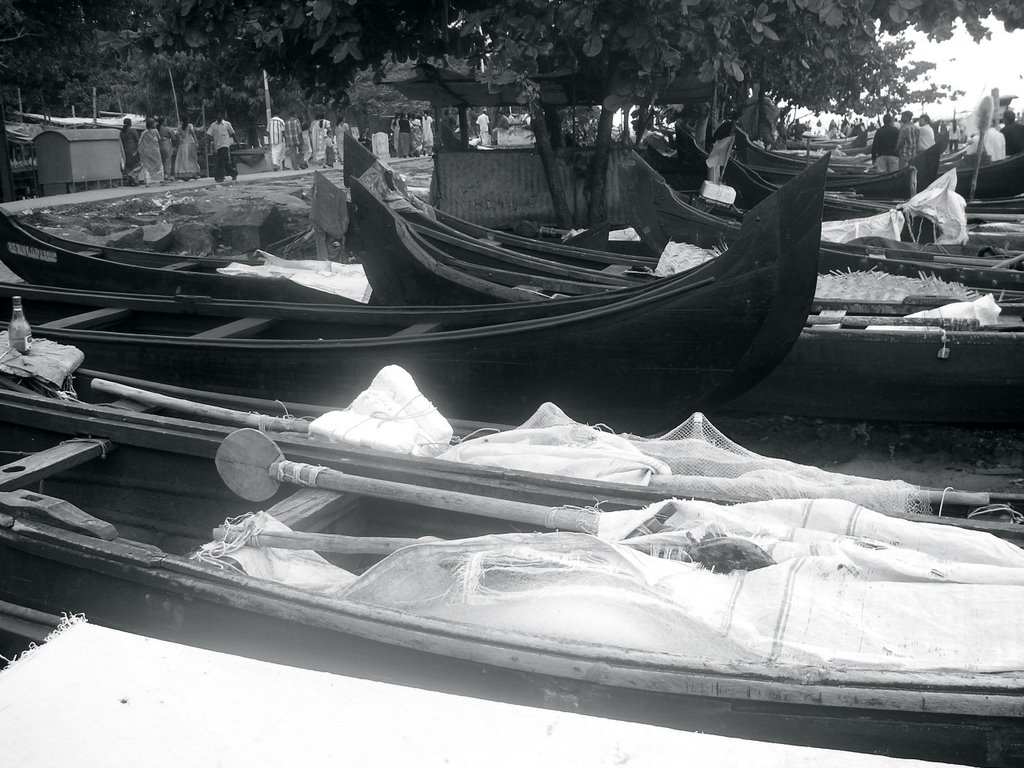
This past weekend was Vesak (Buddha's birthday, enlightenment and death day) so the whole country was lit up with lovely paper lanterns and gaudy Xmas lights. Some communities shelled out 30,000 USD to purchase these monstrous large, plastic, flashing light, carnival-looking structures that depict a story from Buddha's life. People hand out free food, ice cream and soda and there are lantern competitions. So for nearly 2 weeks there are lots of people, very pleasant, cheerful; a complete change from the horrors you see on tv. I also managed to get out of Colombo for the weekend to visit a beach 1 hr north. Expansive, clean beach, with billowing sails on fishing boats, and I was refreshed from the unpolluted air. So there is a huge disparity in how I celebrate life and witness all the bright, cheerfulness of my days around Colombo, and the grim news that I read or hear about. So indeed there is escalating violence, with no end in sight, and no seriousness going on in the peace talks, but there is also the mundane normalcy (however normal you can make of living in South Asia!).

30 April 2006

Market in Fort Cochin


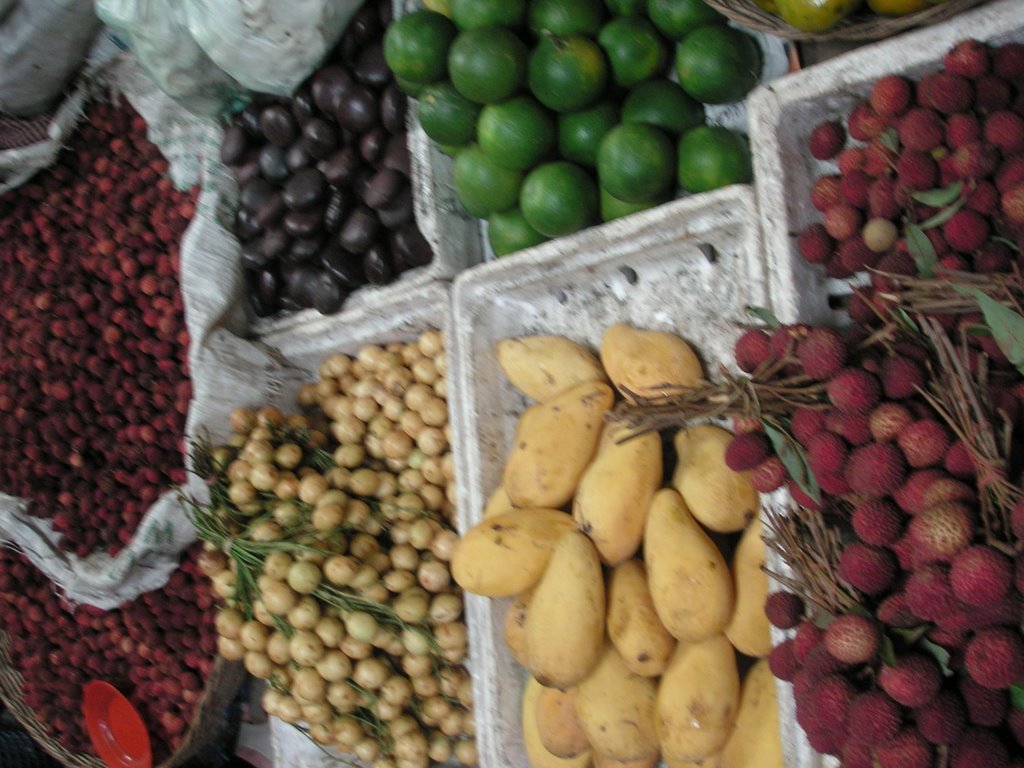
The market and beach at Fort Cochin has everything and is extremely lively. Fishermen sell their day's catch and kiosk restaurants offer to cook and serve the catch to tourists. Local artists sell their etchings and handicrafts; Kerala has put alot of funds and efforts into promoting its local artists and performers. People even sell the latest in camera and portable music technology right there on the beach. At sunset half the city pours onto the beach to dip their feet in the waves and watch fishermen unload their Chinese fishing nets.

Kerala Backwaters


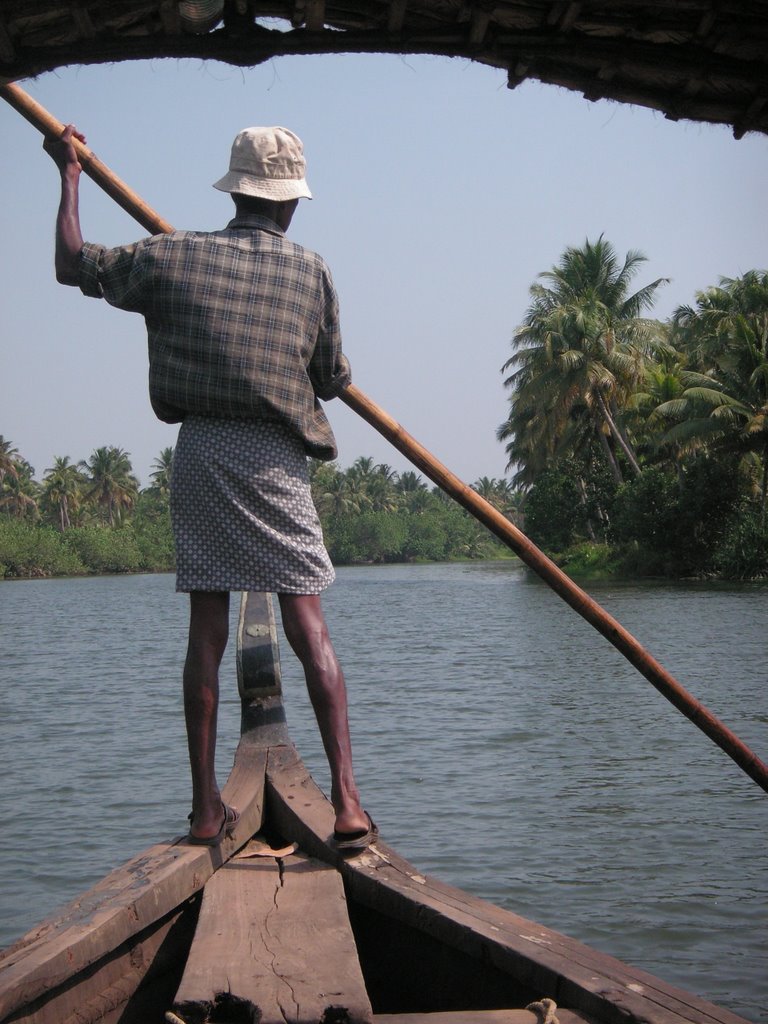
One of the most memorable things about Kerala is its waterways, with small villages dotting the coastlines. The Vishnu festival and Good Friday abbreviated our trek further south, so we hovered around Cochi instead of taking a longer trip to the wildlife sancturaries and beaches. There is just too much to do in this relatively developed Communist, and largely Catholic state! Many of the villlages along the canals earn their income by distilling toddy (illegal moonshine from coconut milk) or processing coir (rope from coconut husks). In addition, there are small factories that process tiny mussles, that are made into calcium fertilisers and concrete supplements. Because it was Vishnu festival many of the villagers had their best clothing on; they had just returned from temple. Quite peaceful and sweltering!

Kerala, southern India


A friend and I took a quick trip to Kerala for the April Hindu New Year. It turned into a ginormous shopping trip, loading up on saris, shalwars, spices, incense, weavings, artwork, nuts and delicacies, ayurvedic products and mahindi henna.

29 April 2006